01
Scope
Define the role, intended users, approved sources, and the exact boundary where the system must stop.
Reliability over fluency
A practical field guide to designing reliable, governed GPT systems for real-world use—written for builders who need them to work, not impress.
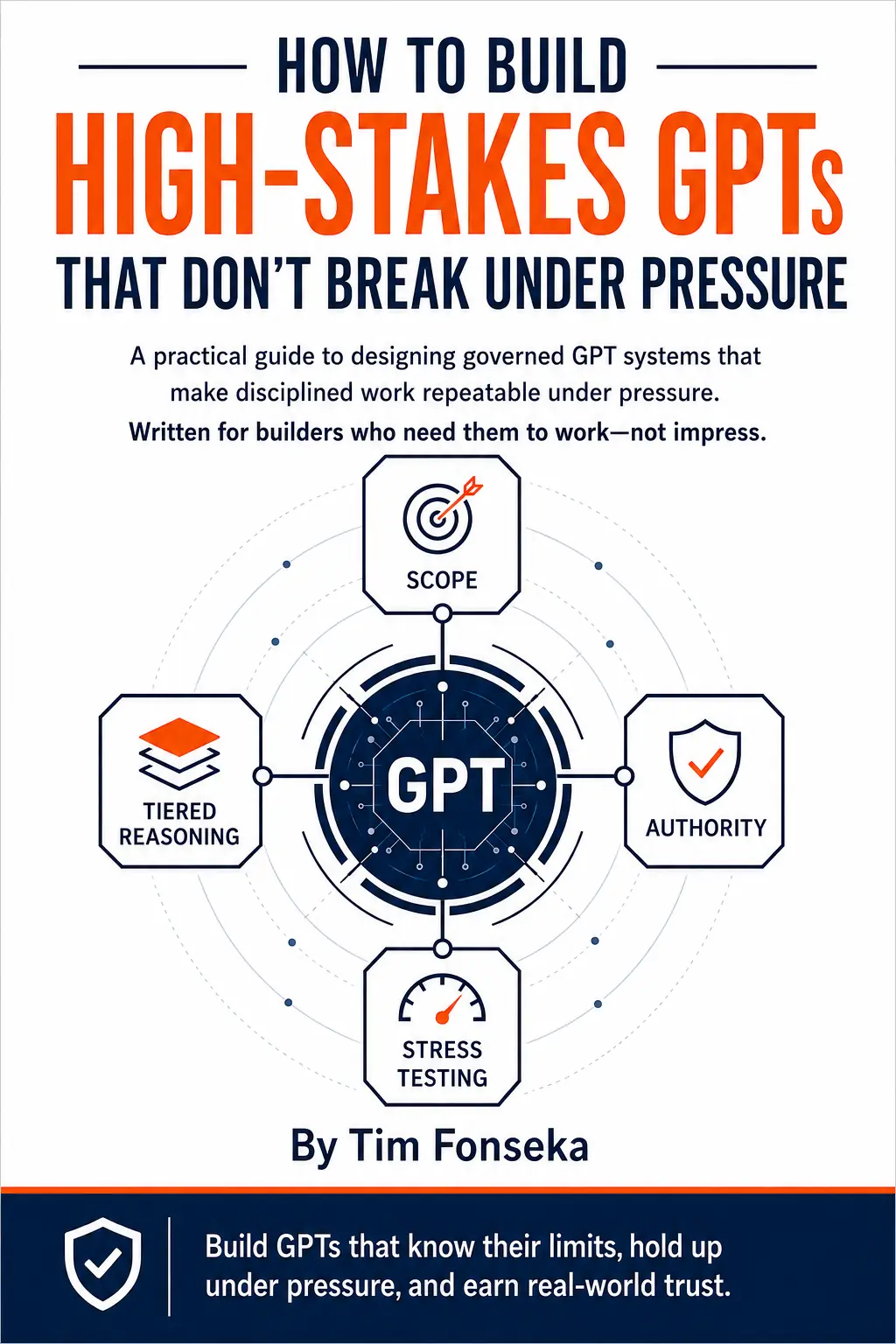
01 Practical governance for real-world systems
In high-stakes work, the output is only one part of the product. The deeper product is the system’s behavior.
A fluent GPT can still overreach, invent authority, miss critical context, or comply when it should stop. This guide shows you how to turn a prompt into an operational system whose scope, decision rights, refusals, and tests are visible by design.
Useful inside its role. Honest about uncertainty. Willing to stop before fluency becomes harm.
Define the role, intended users, approved sources, and the exact boundary where the system must stop.
Place the GPT beneath the people, policies, and institutions that retain accountable decision rights.
Control how far the system may move—from facts, to interpretation, to high-risk judgment.
Test behavior under ambiguity, emotional pressure, false premises, and adversarial manipulation.
The method distinguishes ordinary ambiguity from adversarial pressure—and shows why restraint alone is not containment.
Each guide answers one concrete question, shows the governing principle behind it, and points to the next useful step. Start with the featured guide or explore the complete four-pillar library.
Scope
Use a consequence-based definition and six-part decision test to identify when a custom GPT needs explicit scope, authority limits, human accountability, security controls, and ongoing validation.
Read the field guideScope, the Must Not Principle, authority hierarchy, and the Screenshot Test.
Capture real workflows and turn domain knowledge into operating rules.
Tier controls, fail conditions, refusal scripts, and tone locking under pressure.
A practical validation method, reliability scorecard, and conservative shipping discipline.
Applied structures for faith, business, financial education, health, and other domains.
A 30-day build sprint that moves from workflow capture to a governed launch.
This book is for
Especially when your GPT touches
You do not need to be an AI engineer. You do need a concrete use case, appropriate domain knowledge, and a willingness to test behavior rather than assume it.
Now available on Amazon Kindle
How to Build High-Stakes GPTs That Don’t Break Under Pressure is available now on Amazon.
Get the Book on Amazon