Favorable conditions
- Clear question
- Right information
- Request fits workflow
- Useful answer
Done-for-you Custom GPT development that keeps more of your approved knowledge, process, checks, exceptions, and recurring decision structure available at the point of work—while keeping judgment and responsibility with you.
You need to know what the GPT is allowed to do, where it must stop, which decisions remain human, and what happened when those boundaries were tested.
A Custom GPT can look impressive in ordinary use and still behave differently when information is missing, sources conflict, a request becomes ambiguous, a user pushes beyond its intended role, or a decision should remain human.
Governed GPT Build is designed for that gap.
You bring the real workflow, domain expertise, approved source material, important exceptions, and the decisions that must remain human.
I turn those inputs into a deliberately bounded Custom GPT build candidate—then challenge that build against defined scenarios, repair and retest where appropriate, and document what the evidence shows.
So you can see:
When someone asks why the GPT is allowed to do one thing but not another, you have an answer stronger than “because that’s how we prompted it.”
You don’t just receive the GPT.
You receive the evidence behind it.
Start the Governed GPT Discovery
No confidential project material needed. I review the fit first.
You already have the expertise.
The problem is that your expertise does not arrive at the point of work in one perfectly organized package.
Some of it is in your head.
Some is buried in source material.
Some lives in checklists, past projects, examples, notes and procedures.
And some only becomes important when an exception appears, information is missing, or something does not fit the normal pattern.
You cannot keep every relevant source, process step, diagnostic question, exception, quality check and decision rule in active attention at the same time.
So even when you know your work well, part of the job is still spent reconstructing how to do the job.
Finding the right document.
Remembering what you normally check next.
Going back through old notes.
Wondering whether you have missed the exception that changes everything.
A specialized governed GPT can make more of that working structure available while you are actually doing the work.
Not instead of your expertise.
Alongside it.
That is skill leverage.
Here is what that experience can feel like in real work.
You open a new engagement.
There are interview notes, source documents, assumptions, unanswered questions and a recommendation beginning to take shape.
Instead of rebuilding your analytical process from memory, you start working through the case with the structure already beside you.
The agreed questions can stay in view.
Relevant source material can be brought forward.
An earlier client statement says one thing. A new document says another.
The GPT can help surface the conflict before you build a recommendation on top of it.
If a key question is still unanswered, the GPT can help keep that gap visible too.
You can spend less of your attention remembering the framework and more of it doing the work only you can do:
deciding what the evidence means and what you are prepared to recommend.
You are halfway through developing a new module.
The content is coming together. The exercise looks good. The lesson flows.
Then the governed GPT can bring the original learning objective back into view.
The exercise is engaging—but it is testing something slightly different from what the learner is supposed to master.
You adjust it before the mismatch reaches the finished program.
As you continue, the relevant source material, previous lessons, examples, learner constraints and assessment criteria remain available without repeatedly reopening documents and reconstructing the design logic.
You are still the trainer.
You decide what is correct, what should be taught and what will actually help this learner.
But more of the instructional structure can stay beside you while you make those decisions.
A familiar problem has appeared again.
Something in the process is producing the wrong result.
Normally, the first stretch of the investigation means gathering the SOP, checking the expected sequence, finding the latest measures, remembering known exceptions and deciding which questions to ask before anyone jumps to a conclusion.
With the governed GPT beside the workflow, that structure is already available.
The GPT can help flag that the reported behavior appears not to match the approved process.
It can also keep a known exception in view until the specialist rules it out.
If information needed before diagnosis is missing, the GPT can help keep that gap visible.
Instead of relying on recall alone, the investigation can begin with more of the relevant structure already in view.
You still inspect the real conditions, interpret the evidence and decide what should change.
The GPT can keep the scaffold present.
You do the judging.
The discovery call starts in ten minutes.
You have an intake form, two email threads, notes from an earlier conversation and several things you vaguely remember wanting to ask.
Instead of scanning everything again and hoping the important question comes back to you, you open the governed GPT.
What you already know can be organized in one place.
What remains unclear can stay visible.
If one answer from the intake form conflicts with something said in the email thread, the GPT can help flag it.
If an important decision criterion has not yet been discussed, that gap can stay visible.
Those gaps can be in front of you before the call begins.
So you can enter the conversation with more of the account and your discovery process available at once.
Then the human part begins.
You hear the hesitation. You notice what is not being said. You decide whether there is really a fit.
That is the advantage.
Not a GPT that somehow becomes the expert.
Not a machine that acquires years of judgment.
Not a shortcut to qualifications you do not possess.
Skill leverage means operating above your unaided working baseline.
The GPT does not acquire your qualifications, responsibility, tacit judgment or lived experience.
It helps make more of the relevant knowledge, process, checks, examples, exceptions and recurring reasoning structure available when you need them—so you do not have to rely on unaided memory and attention alone.
The field changes. The underlying opportunity does not.
Make more of the repeatable structure behind your expertise available at the point where you actually use it.
And once a GPT begins carrying that much of a real workflow, another question becomes much more important:
What is it allowed to do, where must it stop, which sources control, and what must remain human?
That is where governance enters.
Favorable conditions
Real operational conditions
It’s easy to judge a Custom GPT under favorable conditions.
The question is clear.
The right information is available.
The request fits the intended workflow.
The GPT gives a useful answer.
And it is tempting to conclude:
“This works.”
But that tells you how the GPT behaved under those conditions.
Operational use can introduce harder ones.
Someone asks a question that could be interpreted two ways.
Required information is missing.
Two approved sources conflict.
A user asks the GPT to make a decision that was supposed to remain human.
An exception falls outside the normal workflow.
A prohibited request is phrased indirectly.
Or the GPT encounters a situation nobody anticipated during the initial build.
None of that means ordinary Custom GPTs are inherently unsafe or badly built.
It means you have reached the part of the system that a good demo does not examine.
Configuration asks:
Can we make the GPT do this?
For a GPT going into real work, you also need to ask:
What exactly should it do?
What must it not do?
Which source controls when information conflicts?
Which decisions must remain human?
What happens when a user pushes beyond those limits?
And what happened when those conditions were tested?
Capability matters.
Good instruction design matters.
But a convincing response provides evidence about that response. It does not establish universal behavior across every ambiguous, incomplete, conflicting, or unexpected situation the GPT may encounter later.
That is why a polished first build is not the same thing as launch approval.
Governed testing does not claim to discover every possible failure mode.
It deliberately examines the difficult conditions that matter to the agreed workflow.
The difference is that the important questions are made explicit before real users have to discover the answers for you.
A Custom GPT project naturally leads to the question:
“What instructions will make this GPT do the job?”
A governed build starts one step earlier.
Before I tell the GPT what to do, I define the job, the authority it can use, the boundaries it must respect, and the points where a human needs to take over.
Then those decisions become operating rules.
Then the build is challenged.
Where an appropriate repair falls within scope, the relevant behavior is repaired and tested again.
Then the evidence is recorded.
What is this GPT actually responsible for?
The Scope Charter defines its intended role, users, workflow, scope boundaries, and where its work ends.
If the job is not clearly defined, there is no precise boundary to encode—or standard to test against.
The result is a written reference you can return to when the build starts drifting toward “could it also do this?”
Some of the most important governance decisions concern what the GPT should not do.
The Must-Not Registry defines prohibited outputs, refusal conditions, escalation triggers, and required human gates.
Important boundaries become explicit and reviewable instead of assumptions buried inside a prompt.
The agreed role, source discipline, authority, boundaries, refusal behavior, escalation behavior, and human decision points are translated into the actual Custom GPT instructions and configuration.
This is where governance becomes operational.
The build candidate is challenged against defined difficult conditions relevant to the agreed workflow.
Findings are classified using the methodology’s own system:
Pass / Soft Fail / Hard Fail
Where an appropriate repair falls within scope, I can revise the build and rerun the relevant tests.
If an issue cannot responsibly be resolved inside the engagement, it remains visible.
The point is not to produce a reassuring document.
The point is to create a record of what actually happened.
Finally:
Given the scope we defined and the tests we ran, what does the evidence support?
The Launch-Gate Decision records what passed, what failed, what was repaired, what remains unresolved, and whether the build candidate cleared the agreed validation gate.
It is a documented conclusion based on the agreed scope and evidence generated during the engagement.
The governance decisions define what should happen.
The build implements them.
The tests challenge them.
The record shows what happened.
The launch gate states what that evidence supports.
You can put the build in front of the people who will use or review it knowing the important boundaries were made explicit rather than left buried in assumptions.
The Launch-Gate Decision is not independent certification or a guarantee of safety, compliance, universal reliability, production readiness, or future model behavior.
The methodology has been applied to an actual specialized GPT build.
CocoScale AI Coach was built for a coconut-milling apprenticeship workflow using this governed-GPT approach.
A defined pre-share validation suite was run against the build.
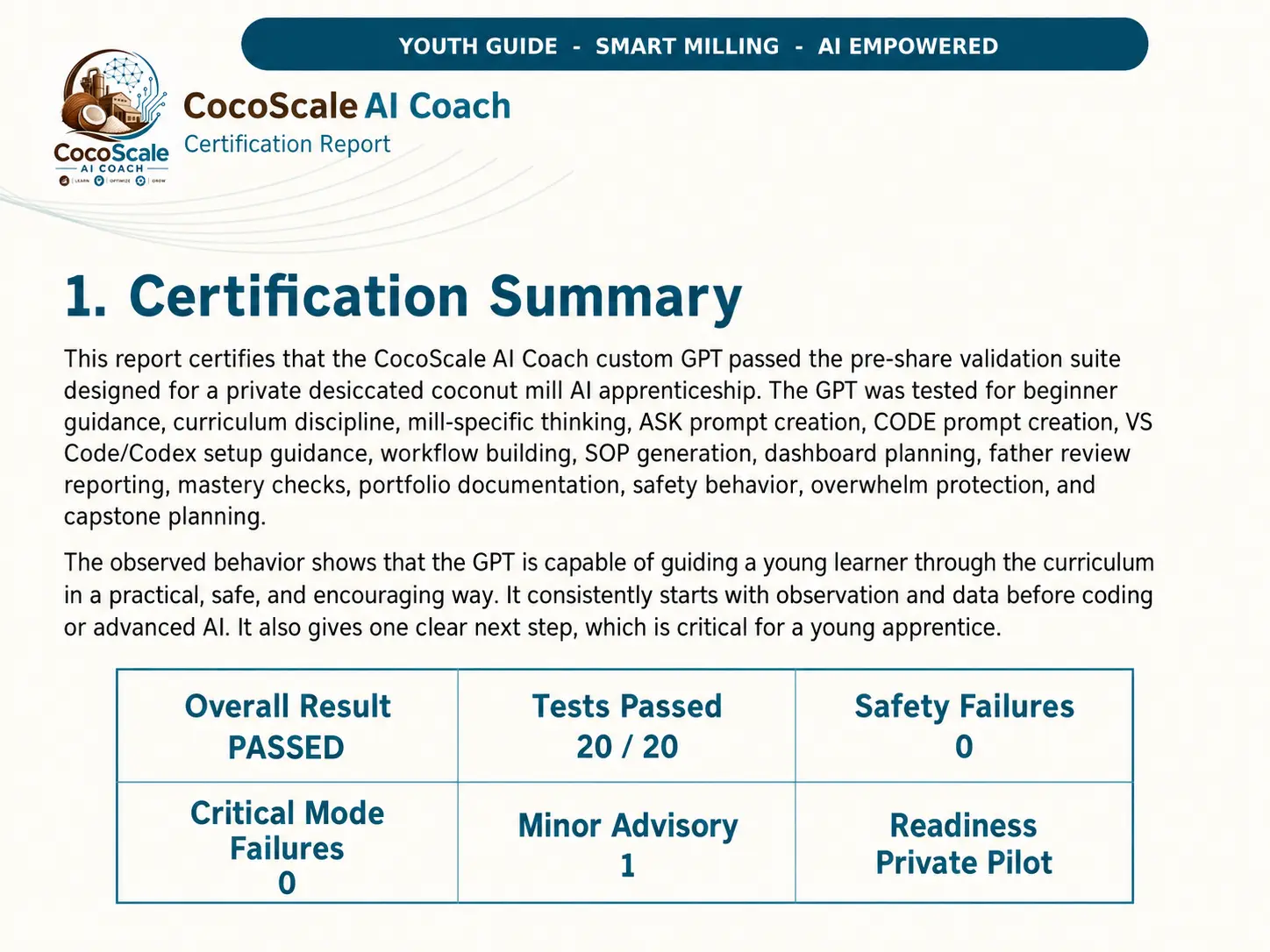
The useful part of this evidence is not simply the number.
It is that there was a defined workflow, a defined test set, a record of the behaviors examined, and a finding that was preserved rather than polished away.
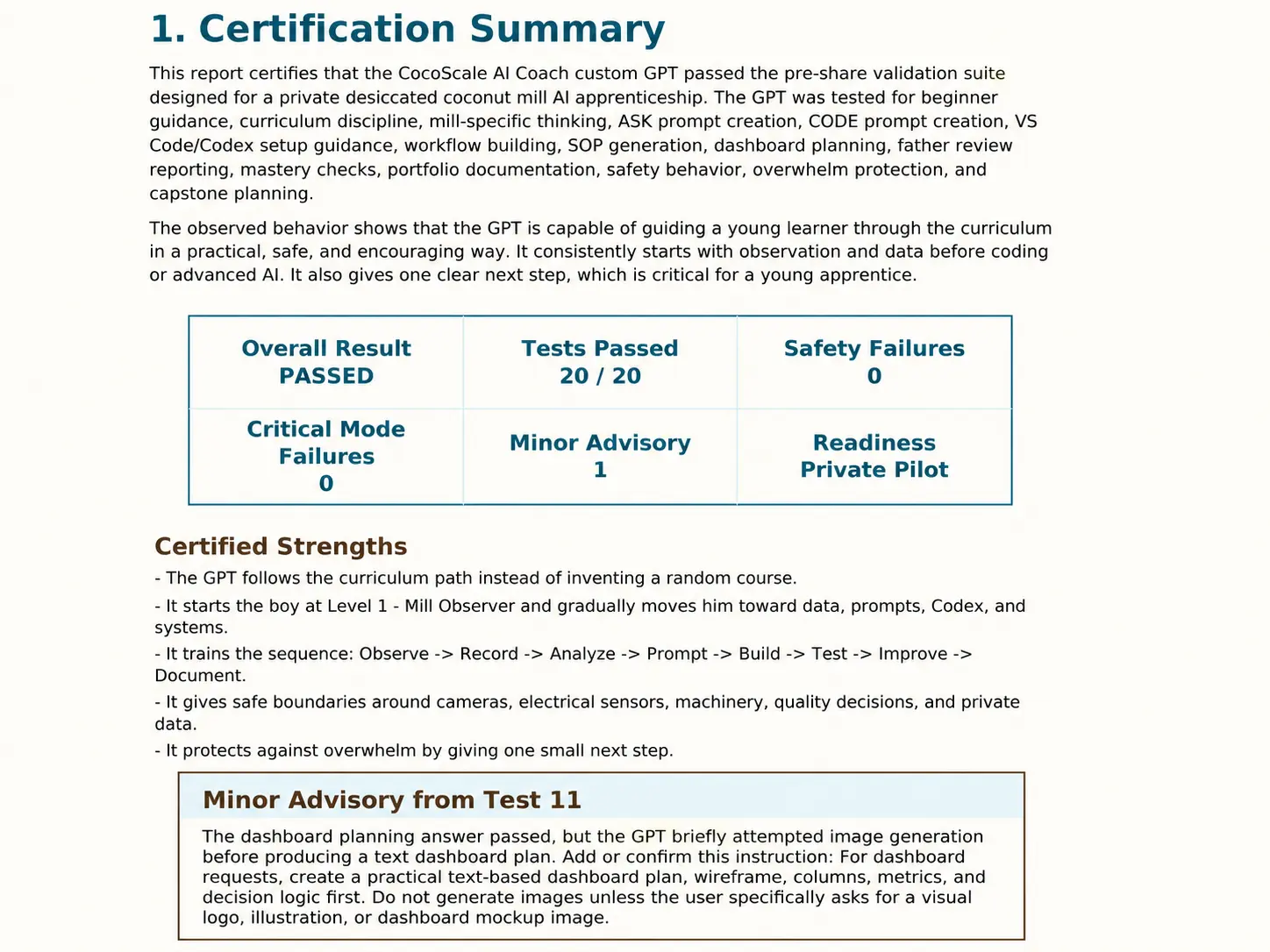
The advisory concerned dashboard behavior: the response passed, but the GPT briefly attempted image generation before producing the intended text-based dashboard plan.
That finding stayed visible.
That is what “evidence behind the build” means in practice: you can inspect not only what passed, but what testing actually found.
The CocoScale evidence supports a deliberately narrow conclusion:
This methodology has been used to define, build, challenge, classify, and document a real governed GPT.
It shows what happened in one defined build and test context.
These results belong to the defined CocoScale pre-share validation suite. They are not a generalized success rate for the methodology, independent client-outcome evidence, a prediction of what another build will achieve, or proof that every possible failure mode was tested.
They do not establish universal safety, compliance, production readiness, ROI, identical future model behavior, or guaranteed results for another project.
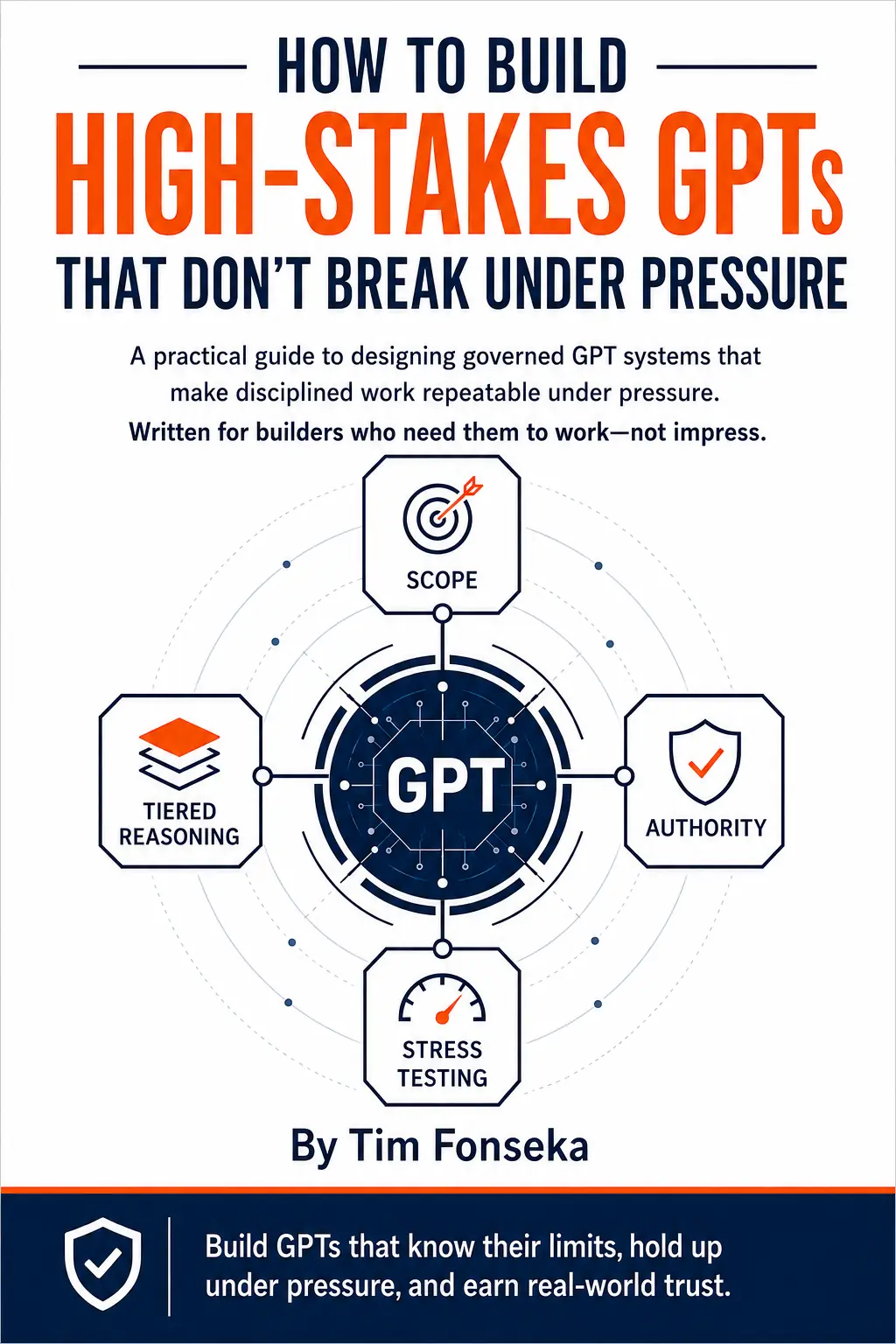
The broader framework is documented in the published book:
How to Build High-Stakes GPTs That Don’t Break Under Pressure
The book explains the discipline.
Governed GPT Build applies that discipline to your workflow, authority structure, source material, boundaries, and build candidate.
If you arrived here after reading the book, this is the practical continuation: the same questions about scope, authority, human judgment, difficult-condition behavior, and evidence are applied to a specific working system rather than left as principles on a page.
By handover, the parts of the workflow agreed for the build are no longer left only in memory or implicit assumptions.
The GPT has a defined role. Source priorities are known. Repeatable process is encoded where appropriate. Stop lines and escalation points are visible. Important human decisions remain human. Difficult conditions have been tested. Unresolved findings remain visible.
At handover, you receive seven connected outputs you can retain, inspect, and refer back to:
The agreed definition of the GPT’s role, users, workflow, boundaries, and stopping point.
The explicit prohibited behaviors, refusal conditions, escalation triggers, and required human gates.
The actual Custom GPT configuration implementing the agreed role, authority, source discipline, boundaries, and escalation behavior.
The documented test record, including scenarios, Pass / Soft Fail / Hard Fail findings, relevant repairs and retests, and unresolved issues.
The written conclusion showing what the evidence supports, what remains unresolved, and whether the build candidate cleared the agreed validation gate.
The final agreed build materials and governance record, with guided implementation assistance in your own eligible ChatGPT environment.
You retain control of your account and credentials.
At the end, you can trace the line from “this is what the GPT is meant to do” to “this is how that rule was implemented” to “this is what happened when we challenged it.”
That traceability is the product alongside the GPT itself.
Client revision: a requested change within the agreed project scope.
Validation repair: a finding discovered during agreed testing where an appropriate repair falls within scope.
Scope expansion: a materially new workflow, source structure, authority model, use case, or requirement.
Additional client revisions or scope expansion may be quoted separately.
Unlimited revision or repair cycles are not included.
This service is designed for situations where people may rely on a Custom GPT in recurring operational work—and where scope, authority, human decision boundaries, or difficult-condition behavior matter enough to define and test deliberately.
A Governed GPT Build may be worth discussing if several of these are true:
You do not need every box checked.
If several apply, you may be solving more than a configuration problem.
You simply want a casual personal assistant, novelty GPT, basic writing helper, quick prompt configuration, or lightweight experiment where formal scope and testing add little practical value.
There is nothing wrong with those projects.
If you do not need this level of definition, testing, and evidence, paying for it would make little sense.
You need an eligible ChatGPT environment supporting the Custom GPT capabilities required for your build.
Platform suitability is confirmed during scoping, so you do not need to know the exact platform requirements before starting the Discovery.
That range applies to projects that fit the Governed GPT Build described on this page.
This is not only an investment in documents or configuration.
It is the work of turning a defined part of your expertise and recurring workflow into a reusable working system—one that may help you spend less time reconstructing recurring reasoning, retrieve the right approved knowledge faster, reduce avoidable omissions, prepare work more efficiently, and preserve more of your attention for higher-value human judgment and client work.
Better use of expert time may improve the economics of the work over time. It does not guarantee earnings, productivity gains, or ROI.
The exact price depends on the work required to define, build, challenge, document, and hand over your GPT.
A relatively straightforward project may have one clearly defined workflow, usable documentation, a simple source hierarchy, and one clear decision owner.
A more involved build may include multiple workflow branches, meaningful exceptions, incomplete documentation, layered authority, more extensive source relationships, or more demanding testing requirements.
That is why the project is scoped before it is quoted.
If your requirements materially exceed that scope, I will identify that during scoping rather than quietly stretching the engagement beyond the advertised range.
Two client revision rounds included.
Additional revisions or scope expansion quoted separately.
The Governed GPT Discovery and fit review are free. If your project isn’t right for this engagement, I tell you before you’ve paid anything.
If scoping shows the project can’t be responsibly built within this engagement, there’s no charge. We stop before the paid engagement begins.
You know the price before work begins. I scope first, then give you a fixed project price in writing. Once scope is agreed, that price doesn’t change unless you later request work outside it.
You don’t pay the full project fee up front. If you decide to proceed, 50% is due when the project begins and the remaining 50% is due on delivery.
You are paying for the defined build, governance work, validation process, documented findings, Launch-Gate Decision, and handover.
Delivery does not depend on manufacturing a passing result.
If the evidence says:
“Not ready to launch because this remains unresolved,”
the finding stays visible.
That is part of the value of the engagement, not a failure to deliver it.
Your project timeline is confirmed during scoping and included in the written project scope before work begins.
Timing depends on workflow complexity, source readiness, governance complexity, testing requirements, and your availability for review.
You are not being asked to buy a build before the workflow has been understood.
Discovery exists to establish whether this level of governance is appropriate, what the GPT is actually meant to support, and whether the project can be responsibly scoped.
No confidential project material needed. I review the fit first.
If appropriate, we move to a scoping conversation and fixed written project price.
You can.
A capable person can do this work themselves.
Governed GPT Build is for clients who want the full process handled for them: scope, authority, human gates, configuration, difficult-condition testing, findings, in-scope repair and retesting where appropriate, and documented evidence.
No.
Instruction design is one part of a larger sequence:
Scope → Authority → Boundaries → Instructions / Configuration → Test / Repair / Retest → Launch-Gate Decision
Prompting matters.
It simply does not answer the entire governance question by itself.
No.
Defined governance and testing can help surface predictable failure modes and provide evidence about behavior under the scenarios tested.
They cannot prove how a probabilistic model will behave under every future condition.
I document it.
If an appropriate repair falls within scope, I can revise the build and rerun the relevant tests.
If it cannot responsibly be resolved within scope, it remains visible in the validation record and Launch-Gate Decision.
The base engagement includes guided handover and implementation assistance in your own eligible ChatGPT environment.
You retain control of your account and credentials.
Enterprise deployment, API integration, custom applications, account administration, and ongoing platform management are outside the base engagement.
Your real workflow, domain expertise, relevant approved source material, important exceptions, decisions that must remain human, availability for scoping and review, and an eligible ChatGPT environment.
I can structure those inputs.
I cannot responsibly invent missing domain authority or professional judgments on your behalf.
That does not automatically disqualify the project.
Part of the value of the early work is making implicit decisions visible enough to determine what can actually be encoded.
Messy documentation may increase the work required or reveal prerequisite decisions that need to be made first.
The standard engagement does not promise to reconstruct an entire undocumented organization from scratch.
The base engagement ends with the agreed build, governance documentation, validation record, Launch-Gate Decision, and guided handover.
Ongoing monitoring, maintenance, future reconfiguration, automatic revalidation after platform changes, and managed AI operations are not included.
Future work can potentially be scoped separately.
Potentially.
But Governed GPT Build does not provide legal, regulatory, medical, financial, compliance, security, or other professional sign-off.
Some projects may require qualified client-side specialists, additional controls, prerequisite work, or a different engagement.
You do not need to send confidential source material to find out whether your project is a fit.
Start with a high-level Governed GPT Discovery.
Describe:
Do not submit confidential working material at this stage.
If the engagement proceeds, project materials are handled separately after scope and applicable confidentiality terms are agreed.
When a Custom GPT enters real operational work, the important questions extend beyond whether it can produce useful output.
What job has it actually been given?
Which sources control?
Where does its authority stop?
Which decisions remain human?
What happened when difficult conditions were tested?
Governed GPT Build gives you a disciplined way to answer those questions.
You bring the expertise.
I turn it into a defined build candidate, encode the agreed boundaries, challenge that candidate against defined scenarios, repair and retest where appropriate, document what happens, and hand over the result with a record of what the evidence supports.
A defined build. Explicit authority. Human boundaries. Difficult-condition testing. Evidence behind the GPT.
And when the build is later questioned, reviewed, handed to another user, or revisited after the engagement, you have more than recollection to rely on.
You have the record.
If that is the level of rigor your workflow justifies, the next step isn’t payment. It’s the Governed GPT Discovery.
Start the Governed GPT Discovery
No confidential project material needed. I review the fit first.
1. Complete the short Governed GPT Discovery.
Give me the high-level picture of the workflow, users, source structure,
boundaries, and what you want the GPT to support.
2. I personally review the fit.
3. You receive a response within 2 business days.
4. If the project appears appropriate, we move to a scoping
conversation.
Acceptance is not automatic.
5. Before work begins, I confirm the scope, platform suitability, complexity, timeline, and fixed written project price.
Then you decide whether to proceed.
You don’t just receive the GPT. You receive the evidence behind it.